Chapter 13: Establishing Bases — Robot-Led
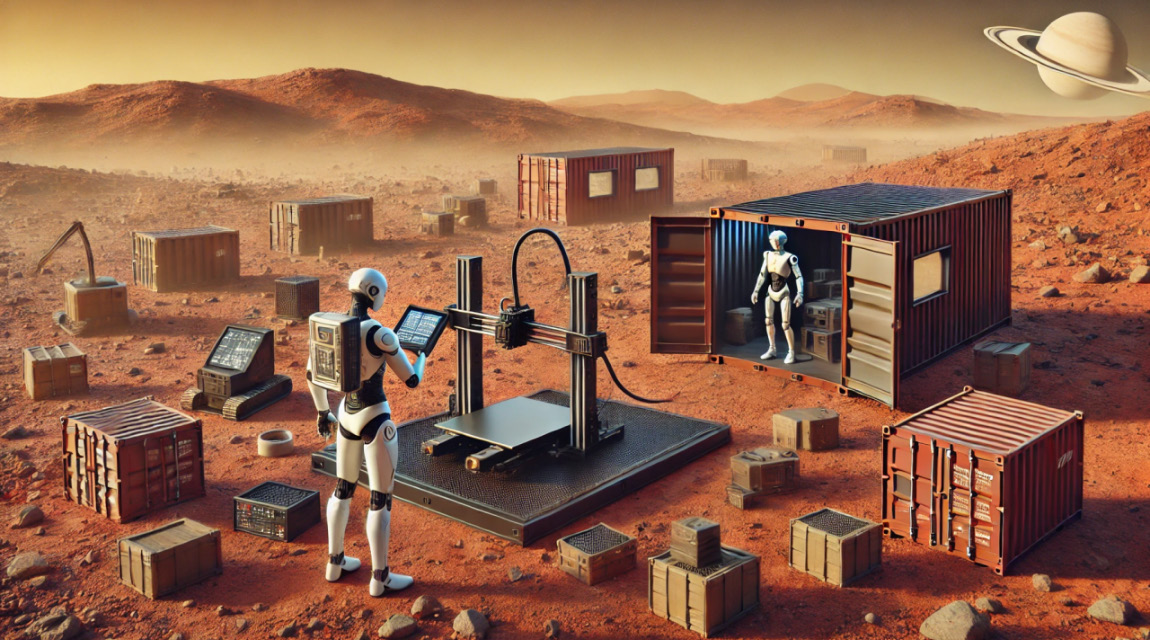
To save transportation costs, the initial investment consists of 10 containers of materials as the foundation for starting construction. The core idea is to use 76 versatile humanoid robots that, upon arriving on Mars, utilize spare parts and 3D printing to assemble and manufacture a batch of repetitive-labor robots. Then, using all the humanoid robots combined with existing materials on Mars, they carry out building construction, metal smelting, glass production, plastic production, solar photovoltaic panel manufacturing, and more. The containers themselves can be converted into electric boilers for smelting metals. The specific initial investment includes 76 humanoid robots (approximately filling one standard container), thousands of sets of humanoid robot chips (1 each), binocular cameras (1 each), and robot joint motors (28 each, similar to Boston Dynamics' Atlas robot which has approximately 28 joints), filling approximately 2 standard containers. Plus over 100 carbon fiber 3D printers and concrete 3D printers, filling approximately 7 containers. The 76 humanoid robots use humanoid robot core kits combined with carbon fiber 3D printers to print humanoid robot torsos, hands, and feet, forming approximately 1,000 humanoid robots. These humanoid robots are then divided into specialized teams, forming production lines for tool production, metal smelting, glass production, plastic production, concrete production, building construction, solar panel manufacturing, and more, creating over 20 production lines that simultaneously produce various products and build the base. One container holding 76 humanoid robots: The number of humanoid robots that can be stored in one container — a 20-foot standard container (20ft container) has internal dimensions of approximately 5.9m × 2.35m × 2.39m (length × width × height), with a volume of approximately 33 cubic meters. Assuming a standard humanoid robot has dimensions of 1.8m in height, 0.6m in width (shoulder width), and 0.4m in thickness, a single robot's volume is approximately 0.43 cubic meters (considering external parts and actual space occupied). By laying the robots horizontally and stacking them in the container while protecting joints and shells, approximately 76 units can be accommodated. Carbon fiber 3D printers: Carbon fiber is known for its excellent properties of high strength, low density, high temperature resistance, and corrosion resistance, making it one of the star materials in modern materials science. The typical tensile strength range of carbon fiber is 3,500 to 6,000 MPa (megapascals). For comparison, the tensile strength of steel is approximately 400 to 700 MPa, meaning carbon fiber's strength can be 5 to 10 times that of steel. Carbon fiber has an extremely high strength-to-weight ratio, far exceeding steel and aluminum. Carbon fiber density: approximately 1.6 g/cm³ (steel is approximately 7.8 g/cm³, aluminum is approximately 2.7 g/cm³). This gives carbon fiber a strength advantage while maintaining lightweight characteristics, making it the preferred material for aerospace and automotive industries. In the future, there will be a 3D printer that converts carbon dioxide from the air into carbon fiber. Since carbon dioxide (CO2) is a highly stable molecule, converting it into carbon fiber requires breaking the C=O double bonds and reassembling them into carbon atom chains. This process Part II: Establishment requires efficient catalysts, electrical energy input, and high-temperature carbonization of polymers (such as PAN, polyacrylonitrile), followed by direct deposition and printing using 3D printing technology to form carbon fiber, creating various high-strength, low-weight equipment materials. Mars concrete 3D printers: Using sulfur as a binder, mixing Mars soil (regolith) and sulfur, heating and cooling to form sulfur concrete. Specific technical steps: Extract sulfur from Martian soil (Mars soil is rich in sulfates; after extraction, heat to 140-150°C to liquefy). Mix Martian soil particles with liquefied sulfur in proportion, pour into 3D printer nozzles, and directly print large quantities of buildings.