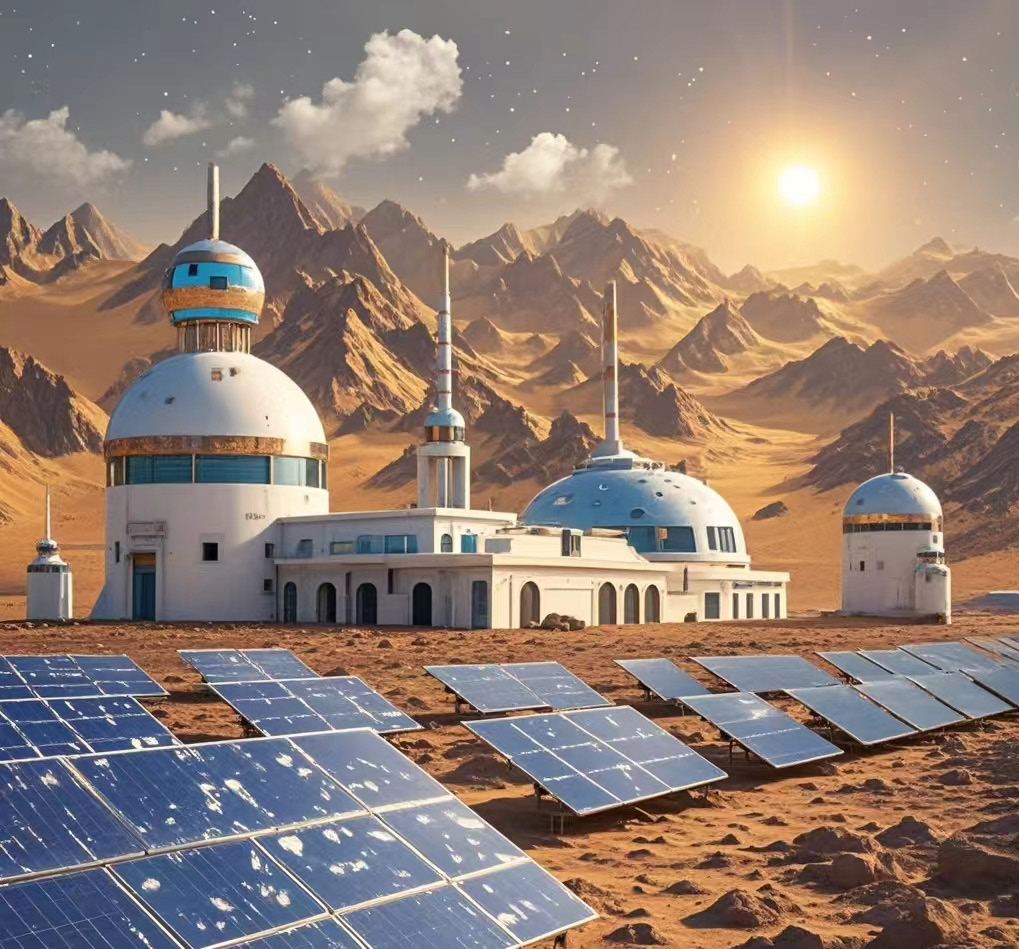
Chapter 30: Energy Solutions and National Energy Policy
The Mars Federation's energy policy will focus on promoting the combined use of solar energy and small-scale fusion facilities, aiming to achieve sustainability and efficiency in energy supply. Mars' energy demand mainly comes from two sources: residential life and industrial production. To address Mars' unique environmental challenges, such as thin atmosphere, long day-night cycles, and extreme temperature variations, the Mars Federation's energy policy not only emphasizes technological innovation but also stresses distributed energy management and efficient utilization. First, solar energy will occupy a significant position in the Mars Federation's energy strategy. The solar radiation received on the Martian surface is about 43% of that on Earth, making solar energy an ideal choice for Martian energy. The Mars Federation will heavily invest in solar technology, including high-efficiency solar panels and solar collectors that can operate stably for long periods in the Martian environment. These technologies will be widely deployed across different regions of Mars, especially in densely populated and industrially active areas. By constructing large-scale solar power facilities, the Mars Federation hopes to meet most of its energy needs and reduce dependence on other energy forms. In addition to solar energy, the Mars Federation will also develop small-scale fusion facilities to supplement solar energy's shortcomings. Nuclear fusion is an ideal choice for future energy, possessing enormous energy potential and theoretically having almost no pollution and waste problems. The Mars Federation will focus on researching and developing small-scale fusion reactors that can provide a stable energy supply for Mars. As Mars' energy demand may grow with urbanization and industrial expansion, small-scale fusion facilities will become a crucial supplement, especially when solar energy cannot fully meet the demand. The use of small-scale fusion facilities will significantly improve the stability and reliability of energy supply, avoiding energy shortages caused by weather changes or insufficient sunlight. The Mars Federation's energy policy will also promote the construction of distributed energy supply systems. This means establishing small, flexible energy production facilities near residential and industrial areas across Mars, thereby reducing dependence on large-scale power grids. This distributed energy model can not only improve energy efficiency and reduce energy loss during transmission but also enhance the disaster resistance of Mars' energy supply system. For example, during natural disasters or system failures, distributed energy supply systems can ensure that energy demands in critical areas are not affected, guaranteeing the normal operation of residential life and industrial production.
1. Solar Energy
Solar energy will become the cornerstone of Mars' energy structure. Although the solar energy received on the Martian surface is only about half of that on Earth, this resource can be fully utilized through high-efficiency solar panels. Solar panels will be deployed on the roofs and open areas of Mars bases to capture the maximum amount of sunlight. Solar energy technologies: Crystalline silicon solar cells: This is currently the most mature and widely used solar technology. It includes monocrystalline and polycrystalline silicon solar cells, which have high photoelectric conversion efficiency but relatively high costs. The photoelectric conversion efficiency of monocrystalline silicon solar cells is between 15% and 23%, while polycrystalline silicon solar cells have an efficiency of 14% to 16%. Thin-film solar cells: These cells use thin-film materials (such as amorphous silicon, copper indium gallium selenide CIGS, copper zinc tin sulfide CZTS, etc.) as matrix materials, with advantages of low cost, light weight, and flexibility. The conversion efficiency of thin-film solar cells is usually lower than that of crystalline silicon cells, but the cost is also relatively lower. Perovskite solar cells: This is a new type of solar cell technology with potential for high efficiency and low cost. Perovskite batteries can be manufactured through solution processing, making production costs lower. The efficiency of perovskite solar cells in laboratories is already very close to traditional silicon-based solar cells and has the potential to achieve even higher efficiency. Organic thin-film solar cells: These solar cells use organic materials as light-absorbing materials, featuring flexibility and roll-to-roll production characteristics, suitable for wearable devices and building-integrated photovoltaics (BIPV). Dye-sensitized solar cells: These batteries mimic the principle of photosynthesis in plants, using dye sensitizers to absorb light energy and convert it into electrical energy. Quantum dot solar cells: This is a solar cell based on quantum dot materials, with potential for high efficiency and high stability. Building-integrated photovoltaics (BIPV): This technology integrates solar cells into building materials such as windows, exterior walls, and roofs, allowing the building itself to generate electricity. In terms of power generation efficiency, currently commercial solar panels generally have an efficiency between 15% and 20%. High-efficiency solar cells under research and development in laboratories, such as perovskite solar cells and multi-junction solar cells, can achieve efficiencies of over 22%, even exceeding 47.1%. With continuous technological advancement, the efficiency and cost-effectiveness of solar cells are constantly improving.
2. Fusion Energy
Fusion technology, especially using deuterium and tritium fusion reactions, is positioned as the core of the energy policy due to its high energy output and clean operational characteristics. Nuclear fusion can not only provide almost unlimited energy but also does not produce greenhouse gas emissions or long-lived radioactive waste. Nuclear fusion technology is a potential clean energy technology that simulates the process of energy generation in the sun, by combining light atomic nuclei (such as the hydrogen isotopes deuterium and tritium) into heavier atomic nuclei (such as helium) under extremely high temperatures and pressures, thereby releasing enormous energy. Nuclear fusion has several significant advantages: it can generate tremendous energy, has abundant fuel sources (such as deuterium in seawater), and produces relatively little radioactive waste. Currently, there are two main methods to achieve controlled nuclear fusion: magnetic confinement fusion and inertial confinement fusion. Magnetic confinement fusion: This method uses strong magnetic fields to confine high-temperature plasma, preventing it from contacting the reactor wall. The tokamak is a device that achieves magnetic confinement fusion, shaped like a doughnut, which confines plasma through magnetic fields, allowing nuclear fusion reactions to occur at high temperatures. China's EAST (Experimental Advanced Superconducting Tokamak) is a representative device in this field, having set world records by maintaining high-temperature plasma for 101 seconds at 120 million degrees Celsius, and for 20 seconds at 160 million degrees Celsius. Inertial confinement fusion: This method uses high-energy lasers or particle beams to irradiate a small target containing fusion fuel for an extremely short time, causing it to implode and produce a fusion reaction. The National Ignition Facility (NIF) in the United States is a facility for conducting inertial confinement fusion experiments, using 192 laser beams to achieve this process. Challenges facing controlled fusion technology include three aspects. High temperature and high pressure: The fuel needs to be heated to temperatures exceeding 100 million degrees Celsius while maintaining sufficient pressure to promote atomic nucleus fusion. Plasma stability: At such high temperatures, plasma behavior becomes very complex and requires precise control to prevent it from contacting the reactor wall or escaping. Energy gain: Currently, the achieved energy output has not exceeded the input energy, which is a key obstacle to commercialization. Despite these challenges, scientists have made significant progress in this field. For example, China's "artificial sun" EAST has achieved the world's latest records of maintaining high-temperature plasma for 101 seconds at 120 million degrees Celsius and for 20 seconds at 160 million degrees Celsius, marking an important step toward achieving controlled fusion. Development