Chapter 20: National Defense
The Mars Federation's national defense policy will focus on establishing a defense force composed of AI robots to safeguard Mars's independence and sovereignty.
1. National Defense Force Construction: The Mars Federation's Security Guarantee
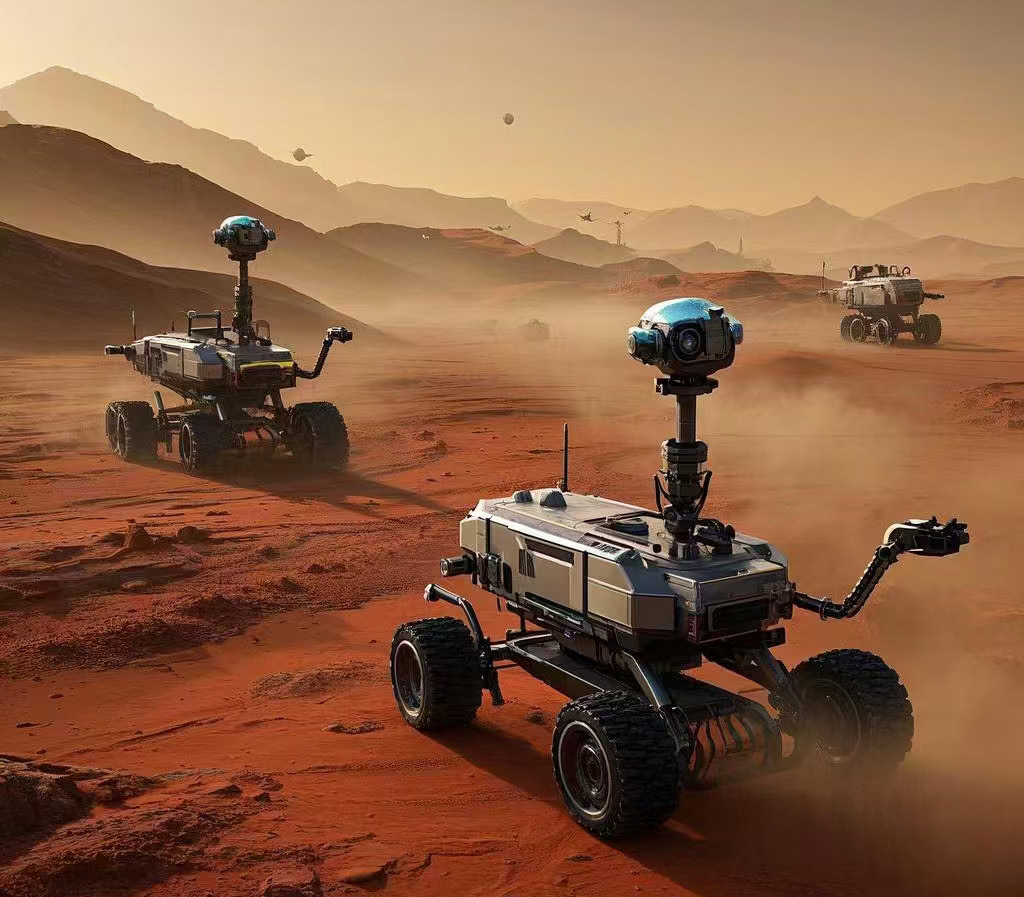
With the establishment of the Mars Federation and the advancement of urbanization, building a powerful national defense force has become key to ensuring Mars's long-term stability and security. Mars's environment is complex and filled with unknown threats. Ground and aerial robots will become the core of the Mars Federation's defense force. These robots, through highly automated systems, will undertake daily security patrols, border monitoring, and defense tasks, becoming the backbone of the Mars Federation's defense system. First, ground robots will be responsible for daily patrol tasks at Mars cities and bases, ensuring that no unauthorized personnel Part II: Establishment or items enter protected areas. These robots are equipped with advanced sensors and automated patrol systems that can monitor abnormal activities in the Mars environment in real time. They will connect with security systems at ground buildings, resource extraction sites, and residential areas, ensuring all areas are under efficient surveillance. Ground robots can not only conduct routine security patrols but also react quickly in emergency situations, executing emergency defense tasks. Aerial robots will be responsible for border monitoring and air defense tasks above Mars. Due to Mars's thin atmosphere and harsh weather conditions, aerial monitoring becomes particularly important. Aerial robots can utilize Mars's unique atmospheric environment for rapid maneuvers and coordinate actions with ground robots via satellites. Their tasks include not only defending against external threats but also providing air support within the Mars Federation, protecting key facilities and personnel safety. Overall, the Mars Federation's national defense force construction is not only to address external threats but also to ensure social order and resource security on an unfamiliar and unstable planet. The coordinated operations of ground and aerial robots will form a comprehensive defense system, effectively protecting the Mars Federation's long-term development.
2. National Defense Technology R&D: The Mars Federation's Future Defense Innovation
To address multiple security challenges in the Mars environment, the Mars Federation will heavily invest in national defense technology research and development. These technologies cover not only new sensors and automated weapons systems but also communication technologies and more, aimed at improving the Mars Federation's defense capabilities and ensuring it can address various threats from both external and internal sources. First, Mars's thin atmosphere and unstable climate environment pose unique challenges for sensor technology. The Mars Federation will develop high-precision sensors that can adapt to these conditions, monitoring Mars surface activities in real time. These sensors will be deployed in robots and other defense facilities, capable of precisely identifying potential threats. Sensors can not only detect traditional threats but also use advanced algorithms to analyze environmental data, identifying risks such as climate change and geological movements that may affect Mars security. In terms of automated weapons systems, the Mars Federation will develop unmanned combat platforms with high-precision strike capabilities. Due to Mars's thin atmosphere, traditional weapons systems are difficult to adapt to Mars's special environment. By introducing advanced technologies such as laser weapons and plasma weapons, the Mars Federation can effectively defend itself without relying on heavy ground equipment. These automated weapons systems will coordinate with ground robot and aerial robot networks, ensuring the Mars Federation possesses strong response capabilities when facing threats. Additionally, the Mars Federation will increase R&D in communication technology to ensure efficient coordination among various defense systems. Due to the great distance between Mars and Earth, timely and efficient communication is a crucial technical challenge. The Mars Federation will develop low-latency, high-capacity satellite communication technology to ensure information transmission between various defense units is not restricted, thereby safeguarding the overall combat capability of the national defense system. In summary, the Mars Federation's national defense technology R&D will revolve around high-tech means adapted to Mars's unique environment. The development and application of these technologies will greatly enhance the Mars Federation's security protection capabilities, providing solid guarantees for Mars's long-term stable development.
3. Defense Systems
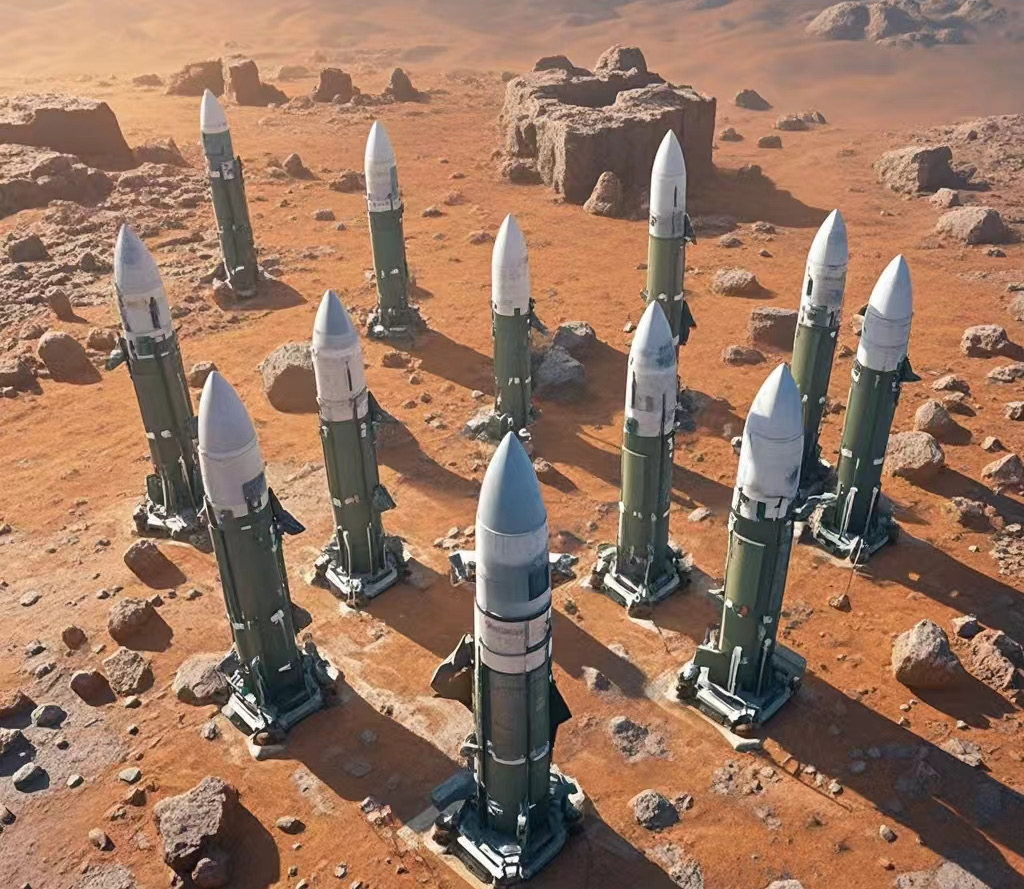
The Mars Federation will deploy a series of automated defense systems, including directed-energy weapons and interception technology, to protect the Mars surface from meteorite and asteroid threats. These systems will be controlled by AI robots, ensuring rapid and accurate responses. Mars Security and Earth Defense Coordination: The Mars Federation's security is not limited to Mars itself but also includes coordinated defense with Earth. 1. Information Sharing Mechanism: In ensuring coordinated defense between Mars and Earth, the information sharing mechanism is the most fundamental and critical component. The Mars Federation plans to establish a highly integrated security information sharing platform with Earth. This platform is not merely a technical tool but a bridge of mutual trust between the two. Through this platform, Mars and Earth can exchange data on potential threats in real time, such as asteroid impact warnings, solar storm predictions, and collision risks from orbital debris. This data exchange will cover multi-source data from Mars orbit detectors to Earth space stations, including radar signals, infrared detection, optical imaging, and other multi-dimensional information. The advantage of this information sharing mechanism is reflected not only in the speed of threat warning but also in the coordination of both parties' response strategies. For example, after detecting a potential asteroid impact risk, Mars and Earth scientific teams can immediately conduct joint analysis through the platform, calculating possible impact ranges and optimal defense plans. Meanwhile, this platform will include AI-based analysis systems that can automatically detect abnormal signals and provide reliable recommendations for decision-makers. Part II: Establishment — Additionally, to ensure data security and integrity, the information sharing platform will adopt advanced blockchain technology and quantum encryption methods. This can not only prevent external cyberattacks but also ensure that information transmission between different nodes is not tampered with or delayed. Ultimately, through this mechanism, Mars and Earth's coordinated defense will be more efficient and precise, providing strong guarantees for the overall security of the solar system. 2. Joint Defense Projects: To better address potential common threats, the Mars Federation plans to launch joint defense projects with Earth nations. The core objective of these projects is to develop and deploy efficient defense systems covering the solar system, focusing on key technologies such as space-based interceptors and early warning satellites. These systems are designed not only for the security needs of Mars and Earth themselves but also considering threats that may exist across the entire solar system, such as asteroid impacts and other space disasters. The Sky Net interceptor is a strategic priority. Mars and Earth plan to jointly develop interceptors that can be rapidly deployed in space. These interceptors can cruise in space, standing ready to address potential impact threats at any time. Once a dangerous celestial body trajectory is detected, interceptors can quickly launch, destroying it or altering its orbit, thereby protecting the safety of Mars and Earth residents. Early warning satellites play the role of sentinels, distributed between Mars and Earth and other important solar system nodes, monitoring the space environment in real time through high-precision sensors. The significance of joint defense projects lies not only in improving technology levels but also in establishing close cooperation between Mars and Earth. Both sides will regularly hold joint exercises simulating various possible threat scenarios, testing system response speed and coordination capabilities. These exercises can also discover system vulnerabilities and provide basis for subsequent improvements. Through these efforts, Mars and Earth will form a mutually supporting security barrier, jointly facing unknown cosmic challenges. 3. Technology and Resource Cooperation: Technology and resource cooperation between Mars and Earth is the core of ensuring both parties' coordinated defense capabilities. In defense technology, the Mars Federation plans to share its latest R&D achievements with Earth nations in areas such as space detectors, orbital defense systems, and high-energy laser weapons. Meanwhile, Mars will also acquire mature military technology and engineering experience from Earth, such as design concepts for missile interception systems and implementation methods for high-precision navigation systems. At the resource level, Mars's abundant rare minerals and Earth's extensive industrial capabilities will form a complementary relationship. Mars can provide rare metals urgently needed by Earth for manufacturing more powerful defense equipment, while Earth can transform these resources into actual defense capabilities through its mature manufacturing system. For example, Earth factories can mass-produce advanced detection satellites for Mars, while Mars can efficiently deploy these devices into space using its orbital resources and low-gravity advantages. Additionally, personnel training is a key aspect of cooperation. Both sides plan to regularly exchange defense personnel, allowing Earth and Mars scientists, engineers, and military commanders to conduct practical operations and research in each other's environments. This cross-planetary personnel exchange can not only enhance technical capabilities but also lay the foundation for cultural exchange and trust-building between both sides. Meanwhile, Mars and Earth universities and research institutions will jointly conduct projects on space defense technology, cultivating more professional talent for the future. Through comprehensive cooperation in technology, resources, and personnel, Mars and Earth will form a powerful defense coalition that can both protect their own security and provide reliable guarantees for the long-term peace of the solar system.
4. Drone Defense Network
The Mars Federation will establish a defense network composed of drones that can be rapidly deployed at low altitude to monitor and intercept potential aerial threats. Drones will be equipped with advanced sensors and communication equipment to achieve coordinated operations with ground defense systems.