Chapter 8: Spacecraft and Landing Technology
1. Innovative Transportation Power Unit
To achieve the journey from Earth to Mars, an innovative small transportation power unit is designed (with built-in battery, solar energy, propellers, and magnetoplasma drive), which will serve as the power source for leaving Earth. This power unit adopts propeller technology, combining a magnetoplasma drive engine and a solar auxiliary system to provide continuous power. The power unit operates primarily with propeller drive within Earth's atmosphere, and activates the magnetoplasma drive engine when flying out of the atmosphere into thin air or vacuum environments. When entering Mars's atmosphere, it uses a combination of propellers and magnetoplasma engines for comprehensive propulsion. Propeller propulsion system: The propeller propulsion system is the spacecraft's primary power source, providing the necessary thrust when departing Earth. These propellers are specially designed to work efficiently in Earth's atmosphere, lifting the aircraft through the atmosphere, while also generating some lift in Mars's thin atmosphere to help the spacecraft achieve a soft landing. Magnetoplasma drive engine: During the journey to Mars and the Mars landing process, due to the thin air and near-vacuum environment, the magnetoplasma drive engine provides continuous power to transport the aircraft to Mars. The energy sources within the drive can include nuclear power and solar energy. Part II: Establishment — Magnetoplasma Drive System Providing Power in Vacuum Environments: The magnetoplasma drive system, also known as a magnetoplasma thruster, is an advanced electric propulsion technology that uses electrical energy to convert propellant into plasma, which is then accelerated and ejected through electromagnetic fields to generate thrust. In vacuum environments, the performance of plasma thrusters is particularly critical, as they are typically used in space, which can be considered a near-perfect vacuum environment. Under vacuum conditions, magnetoplasma thrusters have the following characteristics: 1. High specific impulse: Since there is no atmospheric drag in a vacuum, magnetoplasma thrusters can provide higher specific impulse (i.e., propulsion efficiency), meaning they can deliver more thrust with the same amount of propellant. 2. Continuous thrust: Magnetoplasma thrusters can provide continuous thrust, which is important for long-duration space missions and orbit maintenance. 3. Low thrust levels: Although magnetoplasma thrusters have high specific impulse, the thrust levels they produce are relatively low, typically requiring long acceleration periods to achieve the desired speed. 4. Utilization of electromagnetic fields: In a vacuum, electromagnetic fields are not disturbed as they would be in an atmosphere, so magnetoplasma thrusters can more effectively use electromagnetic fields to accelerate plasma. 5. Plasma generation and control: In a vacuum environment, plasma generation and control are simpler because there is no need to consider interactions with atmospheric components. Differences between ion drive and magnetoplasma drive engines: Besides magnetoplasma drives, we often hear about ion drive engines. In fact, ion drive engines and magnetoplasma drive engines are both key technologies in the modern space propulsion field. Although both are based on electric propulsion principles, they have significant differences in specific implementation and application scenarios. The core of an ion drive engine lies in using electric fields to accelerate single charged ions, ejecting them at extremely high speeds to provide thrust. The main fuel for this type of engine is typically an inert gas (such as xenon). Its principle involves decomposing fuel into positively charged ions through an ionization device, then accelerating these ions through an electrostatic field to eject them, creating a reaction force. Ion drive engines are characterized by extremely low thrust but very high specific impulse, making them highly suitable for long-duration deep space exploration missions, such as NASA's Dawn spacecraft, which successfully relied on ion propulsion to complete its exploration of Vesta and Ceres. Magnetoplasma drive engines use high-temperature ionized gas, i.e., plasma, containing free electrons and ions. Through powerful electromagnetic fields, this plasma is accelerated to high-speed ejection, thereby providing thrust. The advantage of magnetoplasma drive engines is that their thrust is typically higher than that of ion engines, although specific impulse is slightly lower. A typical magnetoplasma drive engine is VASIMR (Variable Specific Impulse Magnetoplasma Rocket), characterized by the ability to adjust the ratio between thrust and efficiency according to mission requirements. Since plasma requires magnetic field confinement and acceleration, the design of this engine is more complex and also requires higher power support. The choice between the two depends on specific mission requirements. If the mission requires long-duration, high-efficiency propulsion, such as deep space missions between Earth and outer planets, ion drive engines are the optimal choice. Magnetoplasma drive engines are more suitable for scenarios with higher thrust requirements, such as cargo transport or larger-scale deep space exploration missions. Solar auxiliary power: Solar panels provide electricity for the spacecraft's plasma drive system and other electronic systems. After departing Earth, solar panels will fully utilize solar radiation in space, providing continuous, infinite energy supply for the spacecraft. Connection between power units and containers: The small transportation power units are connected to containers through an innovative connection mechanism. This connection mechanism not only ensures stability during transport but also enables quick detachment after landing on Mars for subsequent missions. Avoiding rocket launch, using continuous thrust to fly to Mars: Using continuous thrust (driving force) to overcome Earth's gravity, rather than relying on the centrifugal force generated by initial velocity to escape Earth's orbit. This method is theoretically feasible and is actually a technology used in some space missions, especially when multiple orbital maneuvers are needed or when energy conservation is required. Key points of this method: Continuous thrust: Through continuous thrust, work is continuously done on the aircraft, thereby increasing its mechanical energy (kinetic and potential energy). This method does not rely on reaching a specific escape velocity but depends on continuous energy input. Energy conversion: Through solar energy, continuously generating thrust for the plasma drive. Orbital maneuvers: Timely adjustment of the aircraft's trajectory to ensure it can reach Mars. These maneuvers can be achieved through continuous thrust. Gravity loss: As the aircraft continues to ascend, Earth's gravity decreases, meaning that at higher orbits, less thrust is needed to achieve the same acceleration. Mars transfer orbit: Once the aircraft escapes Earth's gravitational field, it continuously accelerates and adjusts direction to ensure it flies toward Mars. Energy efficiency: This method may have advantages in energy efficiency because the propulsion system can operate under optimal energy conditions, rather than in low orbits with greater atmospheric drag. Practical applications: Some deep space probes, such as Voyager and Pioneer, used continuous small thrust to gradually leave Earth and utilized planetary gravity assists to increase speed. Light sail propulsion technology: Light sail propulsion technology is an advanced propulsion method based on photon momentum transfer. Its core concept is to use the interaction between photons and the light sail to provide thrust for the spacecraft. This method does not rely on traditional fuel but transfers thrust to the light sail through photon momentum, thereby propelling the spacecraft forward in space. Although photons have no rest mass, they possess momentum. When Part II: Establishment they strike or reflect off the light sail surface, they generate a tiny force that, through accumulation, can continuously accelerate the aircraft. Light sails are typically made of ultra-lightweight, high-reflectivity materials, such as metalized thin films or other nanotechnology-enhanced materials. To maximize thrust, light sails are often designed with large areas while maintaining sufficient rigidity to preserve their shape and avoid deformation in the space environment. There are two main approaches to light sail propulsion: one utilizes solar radiation pressure, suitable for missions within the solar system; the other relies on ground-based or orbital directed laser beams, providing power support for long-distance deep space exploration missions. Compared to traditional chemical propulsion technology, light sail propulsion has significant advantages. It does not require carrying fuel, thus greatly reducing the weight of the aircraft while also extending mission duration. Although the initial thrust of light sails is small, due to their continuous acceleration characteristics, they can raise the aircraft's speed to extremely high levels over long periods, making them particularly suitable for deep space exploration and interstellar travel. In practical applications, the potential of light sail technology is very broad. For missions within the solar system, light sails can rely on sunlight for power to complete exploration of planets, asteroids, and comets. For interstellar exploration, light sails can be propelled by directed energy from Earth or orbital laser arrays, enabling probes to fly toward nearby star systems at extremely high speeds. Although light sail propulsion technology has broad prospects, it still faces many technical challenges. First, in materials science, more lightweight and durable light sail materials need to be developed that can reflect large amounts of photons while withstanding the harsh conditions of the space environment. Second, regarding thrust, due to the extremely small momentum of photons, the thrust generated by light sails is limited, requiring long periods of accumulation to show effects. Additionally, laser-driven light sails require high-precision laser energy transmission and target positioning capabilities, placing extremely high demands on existing technology levels. With advances in science and technology, the application potential of light sail propulsion technology will gradually expand. It can not only provide reliable propulsion for exploration missions within and beyond the solar system but may also become an important foundation for future interstellar travel. Through continuous technology development and mission practice, humanity may rely on light sail technology to take its first step toward the stars, opening a new era of cosmic exploration. Japan's IKAROS: Japan's exploration in light sail propulsion technology is representative, with its key project being the IKAROS (Interplanetary Kite-craft Accelerated by Radiation Of the Sun) mission led by the Japan Aerospace Exploration Agency (JAXA). The mission was launched on May 21, 2010, alongside the "Akatsuki" Venus climate orbiter, becoming the world's first spacecraft to successfully verify solar sail propulsion technology. The core of the IKAROS project is a square ultra-thin solar sail with 14-meter sides, a total area of approximately 200 square meters, and a thickness of only 7.5 micrometers — one-tenth the thickness of a human hair. It is made of polyimide film with extremely high durability and lightweight characteristics. The sail is coated with high-reflectivity materials to maximize the use of solar photon momentum. IKAROS also embedded flexible solar cells that can convert solar energy into electricity for the detector's operation and communication. IKAROS's primary mission was to drive the spacecraft through solar radiation pressure and verify the actual performance of solar sails in deep space environments. After launch, IKAROS successfully deployed the solar sail, which was a critical technical milestone. The sail deployed in space using centrifugal force, similar to a kite unfurling as it rises. After successful deployment, IKAROS began using solar photon momentum for propulsion, and the spacecraft's speed continuously increased without traditional propellant. In addition to propulsion tests, IKAROS conducted a series of scientific experiments, such as testing the dynamic stability of the solar sail, evaluating the actual effects of solar radiation pressure, and measuring its impact on orbit and attitude. To improve flight precision, IKAROS was equipped with variable reflectivity devices (Liquid Crystal Devices, LCDs) that allow adjustment of the reflectivity in local areas of the sail, enabling active control of the spacecraft's attitude. The IKAROS mission achieved important results in technology verification and scientific exploration. During the mission, IKAROS successfully completed its voyage toward Venus and tested the long-term durability and reliability of the solar sail. The entire mission demonstrated that solar sail propulsion technology can achieve stable operation in deep space environments, laying the foundation for more complex future solar sail missions. IKAROS's success marked an important step for Japan in solar sail technology and served as a demonstration for global solar sail research. JAXA plans to further develop solar sail technology in the future and apply it to larger-scale missions, such as exploring Jupiter and more distant asteroids. Japan's solar sail exploration not only demonstrates its innovation in aerospace technology but also provides important experience for global deep space exploration. United States LightSail 2: LightSail 2 is a solar sail technology verification mission led by The Planetary Society in the United States. The spacecraft was launched on June 25, 2019, aboard SpaceX's Falcon Heavy rocket from Kennedy Space Center in Florida. LightSail 2 was designed to utilize the pressure of solar photons for propulsion without traditional fuel, thereby verifying the feasibility of solar sail technology in Earth orbit. One month after launch, LightSail 2 successfully deployed its ultra-thin Mylar sail with an area of approximately 32 square meters, and by adjusting the sail's angle, utilized solar photon pressure to increase orbital altitude, proving the effectiveness of solar sail technology. During its mission, LightSail 2 orbited Earth more than 18,000 times, with a cumulative flight time exceeding three years. However, over time, the spacecraft was increasingly affected by atmospheric drag, and its orbital altitude continued to decrease. Ultimately, LightSail 2 re-entered Earth's atmosphere on November 17, 2022, completing its mission. LightSail 2's success paved the way for future solar sail missions, providing valuable data and experience. For example, NASA plans to adopt similar solar sail technology in its Near-Earth Asteroid Scout (NEA Scout) mission and Advanced Composite Solar Sail System (ACS3). These missions will utilize solar sails for deep space exploration, further verifying the application potential of solar sails in different mission scenarios. Part II: Establishment — LightSail 2's success demonstrated the feasibility and potential of solar sail technology in space exploration, providing new possibilities for future fuel-free deep space navigation. However, solar sail technology still faces challenges, such as small thrust and slow acceleration. Future research will focus on optimizing sail materials and design, as well as exploring methods to use external light sources such as lasers to provide additional thrust, to improve the performance and applicability of solar sails.
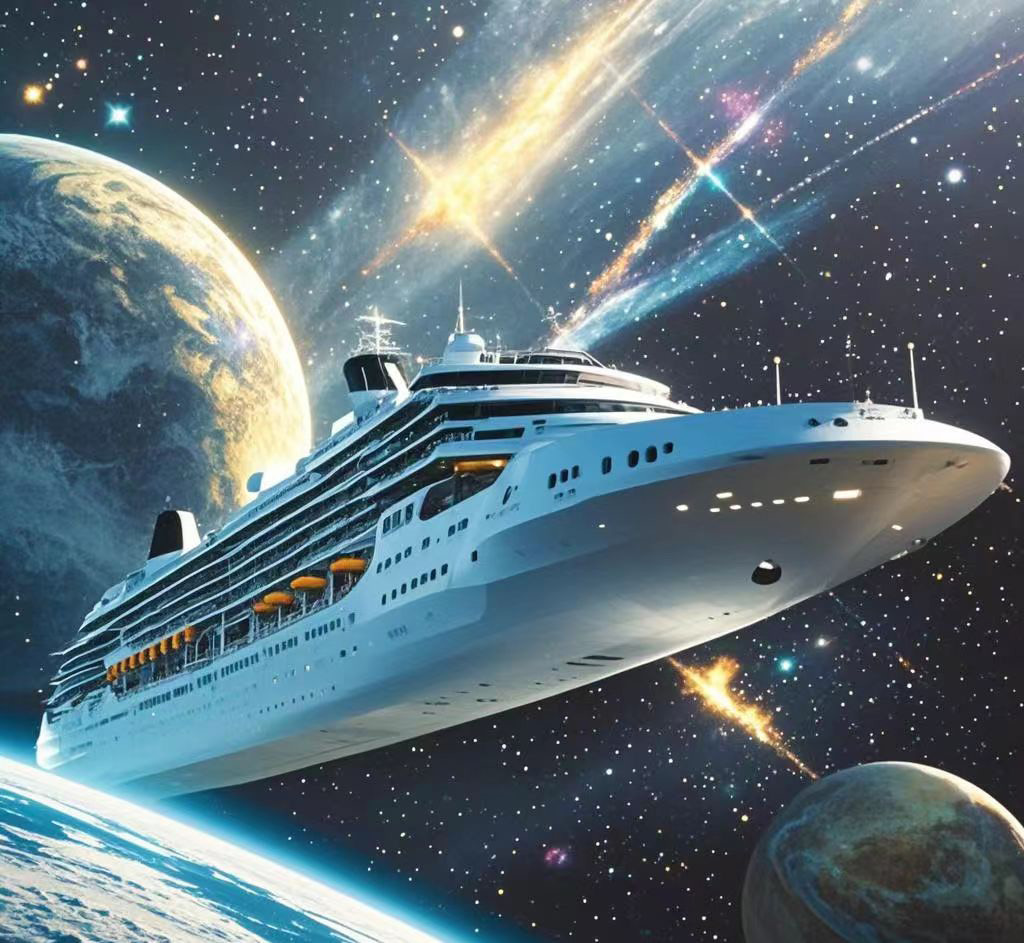
2. Long-Distance Crewed Spacecraft — A Cruise Ship Converted into a Spacecraft
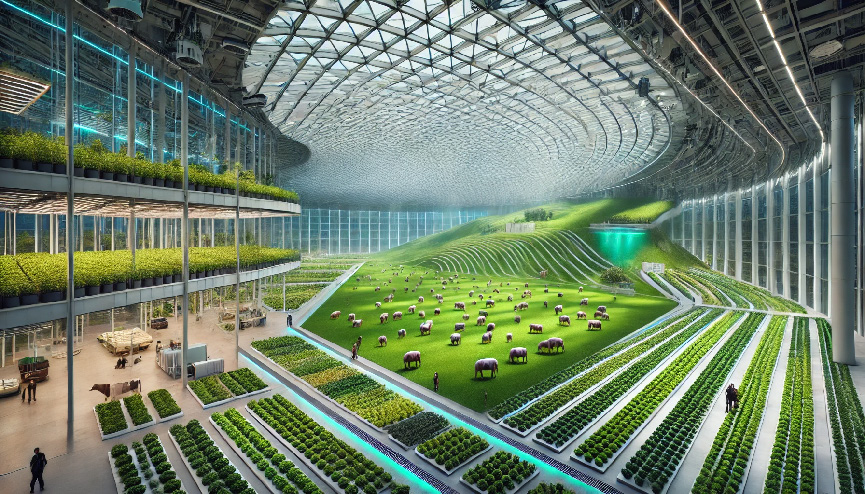
Existing cruise ships feature suites, restaurants, dance halls, swimming pools, exhibition halls, game rooms, and other rich living and entertainment facilities that can satisfy long-distance travel needs. By simply modifying their power systems, closed air systems, and planting and breeding systems, they can quickly be converted into spacecraft. The power system mainly involves installing a small nuclear reactor internally, adding large multi-blade propellers for lifting off from the ground to the edge of the atmosphere, and adding plasma drive units for flying from beyond the atmosphere to Mars. The closed air system mainly involves enhancing the ship's air-tightness, adding oxygen generation equipment, and maintaining the air oxygen content and atmospheric pressure inside the ship. The planting and breeding system mainly involves designating specific areas within the cabins for indoor planting and poultry rearing, continuously providing some fresh food for the people on board and avoiding an entirely refrigerated food diet. It is particularly important to note that after the spacecraft departs Earth, it maintains a near-constant acceleration of approximately one G (adjusted according to Earth and Mars gravity), with the ship's top directed toward Mars, to ensure that the interior of the ship always maintains gravity similar to Earth's, avoiding weightlessness or floating in space. When approaching Mars, the ship's bottom is directed toward Mars to utilize Mars's gravity and avoid weightlessness in space. Spacetime metric flight technology: Based on a comprehensive analysis of the Buga Sphere, typical flying saucers (such as the TR-3B patent design), and historical UFO sighting events, a unified physical framework and structural adaptation principles for three types of anti-gravity technologies can be derived. The following is a systematic deconstruction: I. Comparison of anti-gravity principles among three typical UFO structures. All UFO anti-gravity systems modify the local spacetime metric tensor gµv. 1. Metric modification equation: Einstein's field equation is modified to include engineered energy-momentum tensors. 2. Classification of metric solutions including static spherically symmetric corrections (Buga Sphere), cylindrically symmetric rotating fields (flying saucer propulsion), and negative energy vacuum bubbles (Alcubierre drive). The technical paths differ: 1. Buga Sphere path: Dark matter-matter coupling metric modification. 2. Flying saucer path: Rotating field spacetime dragging, referencing the Gödel metric with Lense-Thirring effect enhancement. 3. Cigar shape path: Vacuum negative energy density through modified Einstein equations. II. Structural adaptability deconstruction: 1. Topological advantages of equatorial rings for different shapes. 2. The necessity of central energy chambers in all UFOs as vacuum polarization engines. 3. Special surface material requirements. III. Key technology identity verification: 1. Energy-information transmission mechanism through quantum entanglement networks. 2. Environmental interference effects with local physical law anomalies. IV. Technology maturity roadmap: laboratory verification by 2028-2030, prototype disc aircraft by 2040-2045, interstellar navigation by 2070+, and cosmic engineering by 2200+. Conclusion: Technical commonality and morphological differentiation — all UFO anti-gravity originates from quantum corrections to the energy-momentum tensor in Einstein's field equations (dark matter polarization/vacuum negative energy/rotating field dragging), essentially spacetime metric engineering. Spherical shapes suit high-dimensional field manipulation, disc shapes optimize 2D plane control efficiency (preferred for human technology), and cigar shapes pursue maximum directed propulsion speed for interstellar travel. Humanity transitions from passengers of spacetime to engineers of spacetime.