Chapter 11: Landing on Mars
1. Entering Mars's Atmosphere
The process of spacecraft and containers entering Mars's atmosphere is a precise and complex engineering challenge. Mars's atmosphere is much thinner than Earth's, with a density of only about 1% of Earth's atmosphere, meaning traditional aerodynamic methods cannot be fully relied upon, and innovative technologies must be used to ensure the aircraft's stable descent. When entering Mars's atmosphere, the aircraft first passes through the upper atmospheric layers, using the small number of air molecules to gradually decelerate through a precisely controlled descent process. The engine's reverse thrust system plays an important role in this process, using the plasma drive to generate reverse thrust in Mars's thin atmosphere, further reducing the aircraft's speed. To avoid entering the Martian surface too quickly and causing destruction, the spacecraft or containers will adopt a gradual deceleration strategy. During this process, the aircraft also needs to make corrections through precise navigation systems, ensuring entry into the atmosphere at an appropriate angle to prevent too-rapid descent from excessive angles or excessive heat generation from too-shallow angles. Additionally, the aircraft will use advanced thermal protection systems to cope with the high temperatures generated during re-entry, protecting internal equipment and crew safety.
2. Landing Site Selection
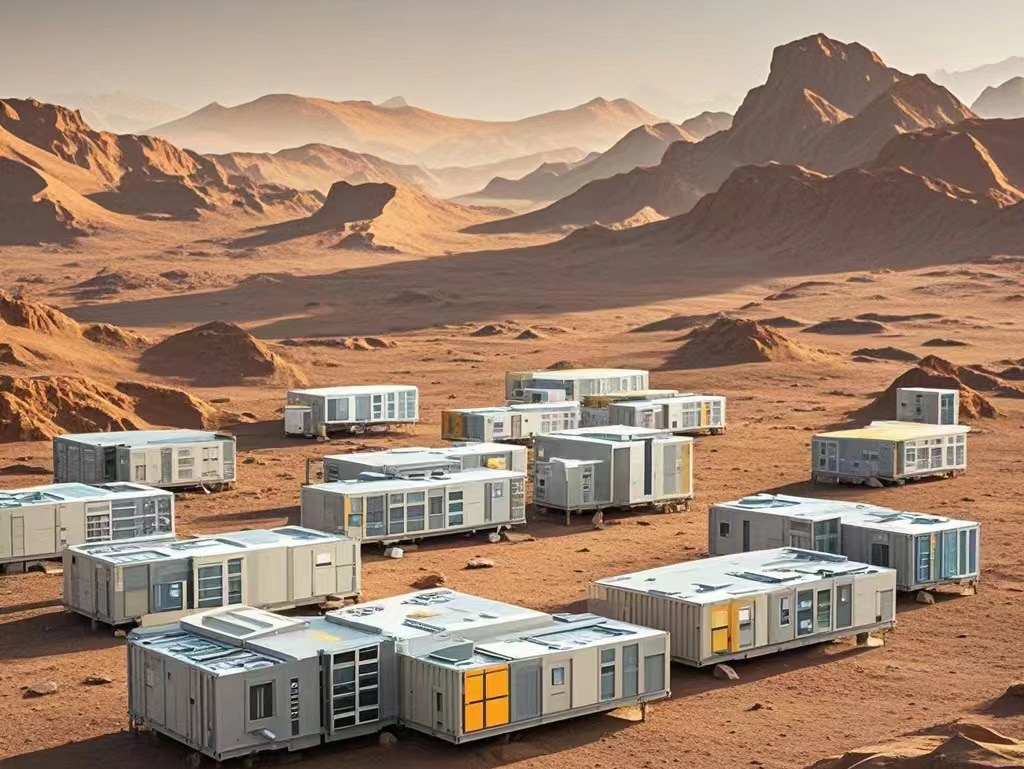
Selecting a landing site is a crucial aspect of Mars exploration missions. On the Martian surface, geologically stable and resource-rich areas are essential for long-term survival and city building. Multiple factors need to be comprehensively considered, including geological stability, solar radiation, underground water sources, and future scalability requirements. Based on these factors, landing site selection will prioritize areas close to water sources and rich in energy resources. Geological stability is the primary condition for landing site selection. Although Mars's surface has some seismic activity and storms, certain geological regions are relatively stable and can provide a reliable landing foundation. Resource-rich areas are particularly important because during Mars's long-term exploration, being able to extract water, oxygen, construction materials, and other resources locally will greatly reduce dependence on Earth's resources. Scientists have discovered through detection instruments that large amounts of underground water ice exist near Mars's north pole, making it an ideal landing area. Additionally, the scalability of future city construction is an important consideration. The landing site must be able to support subsequent base construction, agricultural planting, and resource extraction activities, so the selected area must also have good sunlight conditions to ensure the continuity of solar power generation while guaranteeing sufficient building material supplies. The comprehensive consideration of these conditions ensures that Mars exploration missions have long-term viability and sustainability.
3. Landing Process
The landing process of the spacecraft or containers is a highly precise operation involving multiple complex technologies to ensure the aircraft can land on Mars's surface smoothly and safely. Vertical Takeoff and Landing (VTOL) technology is employed for precision landing in Mars's thin atmosphere. After entering Mars's atmosphere, the aircraft's speed is gradually reduced through atmospheric drag and the reverse thrust of the plasma drive system, entering a more detailed landing phase. First, as the spacecraft or container approaches the Martian surface, it activates the propeller and plasma drive systems. Through aerodynamic and electromagnetically controlled plasma thrust for reverse acceleration, the aircraft's speed can be further reduced, safely transitioning to a low-speed phase. Meanwhile, the aircraft's VTOL system ensures vertical stability with precise control, preventing the aircraft from deviating from its planned trajectory. To address the challenges of Mars's extreme surface environment, the spacecraft is equipped with advanced sensors and navigation systems that monitor flight altitude, speed, atmospheric pressure, and other data in real time, making corresponding adjustments based on terrain and environmental conditions. When the spacecraft is about to land, the precision control system ensures a smooth touchdown, avoiding collisions or tilting. After landing, the aircraft can quickly deploy and support subsequent resource extraction and base construction work, laying the foundation for humanity's survival and development on Mars. Part II: Establishment