第十一章:登陆火星
1. 进入火星大气层
飞船和集装箱进入火星大气层的过程是一次精密而复杂的工程挑战。火星的大气层比地球薄很多,密度仅为地球大气的1%,这意味着传统的空气动力学方法无法完全依赖,必须通过创新的技术来保证飞行器的平稳下降。进入火星大气层时,飞行器首先会经过高空的气层,利用少量的空气分子通过精确控制的降落过程逐步减速。引擎的逆向助力系统将在这一过程中发挥重要作用,它利用等离子体驱动器在火星稀薄的大气中反向产生推力,进一步降低飞行器的速度。为了避免过快地进入火星表面并造成毁坏,飞船或集装箱将采取逐步减速的策略。在此过程中,飞行器还需要通过精确的导航系统进行修正,确保以适当的角度进入大气层,防止角度过大或过小造成过快下降或产生过多的热量。此外,飞行器将利用先进的热防护系统应对再入过程中产生的高温,以保护内部设备和航天员的安全。
2. 降落地点选择
选择降落地点是火星探索任务中的一个至关重要的环节。在火星表面,地质稳定、资源丰富的区域对于长期生存和城市建设至关重要。需要综合考虑多个因素,包括地质稳定性、太阳辐射、地下水源,以及未来可扩展性的需求。在这些因素的基础上,降落地点的选择会优先选择那些接近水源和能源丰富的地区。地质稳定性是降落地点选择的首要条件。火星表面虽然拥有一定的震动和风暴,但一些地质区域相对稳定,能提供可靠的着陆基础。资源丰富的地区则尤为重要,因为在火星的长期探索过程中,能够在当地提取水、氧气、建筑材料等资源将大大降低对地球资源的依赖。科学家已通过探测仪器发现火星北极附近存在大量的地下水冰,成为理想的降落区域。除此之外,未来城市建设的扩展性也是考虑的重要因素。降落地点必须能够支持后续基地建设、农业种植和资源开采等活动,因此选择的区域还须具备较好的日照条件,确保太阳能发电的持续性,同时保证建材的充足供应。这些条件的综合考虑使得火星的探索任务具备长期性和可持续性。
3. 降落过程
飞船或集装箱的降落过程是一次高度精确的操作,涉及多种复杂技术,确保飞行器能够顺利、安全地着陆火星表面。采用垂直起降(VTOL)技术,是为了在火星稀薄的大气层中进行精准着陆。进入火星大气层后,飞行器的速度将通过大气阻力和等离子驱动系统的反向推力逐步降低,进入更为细致的着陆阶段。首先,飞船或集装箱在接近火星表面时,会启动螺旋桨和等离子体驱动系统。通过空气动力、电磁场控制的等离子体推力进行反向加速,这样可以进一步减缓飞行器的速度,使其安全地过渡到低速阶段。与此同时,飞行器的垂直起降系统将以精确的控制方式确保其垂直稳定性,防止飞行器偏离预定轨道。为了应对火星表面极端环境的挑战,飞船将装备先进的传感器和导航系统,实时监测飞行高度、速度、气压等多项数据,并根据地形和环境条件做出相应的调整。当飞船即将着陆时,精准的控制系统会确保飞船平稳地降落,避免碰撞或倾斜。降落后的飞行器将能够快速展开并支持后续的资源采集和基地建设工作,为人类在火星的生存和发展奠定基础。第二部分:建立
Chapter 11: Landing on Mars
1. Entering Mars's Atmosphere
The process of spacecraft and containers entering Mars's atmosphere is a precise and complex engineering challenge. Mars's atmosphere is much thinner than Earth's, with a density of only about 1% of Earth's atmosphere, meaning traditional aerodynamic methods cannot be fully relied upon, and innovative technologies must be used to ensure the aircraft's stable descent. When entering Mars's atmosphere, the aircraft first passes through the upper atmospheric layers, using the small number of air molecules to gradually decelerate through a precisely controlled descent process. The engine's reverse thrust system plays an important role in this process, using the plasma drive to generate reverse thrust in Mars's thin atmosphere, further reducing the aircraft's speed. To avoid entering the Martian surface too quickly and causing destruction, the spacecraft or containers will adopt a gradual deceleration strategy. During this process, the aircraft also needs to make corrections through precise navigation systems, ensuring entry into the atmosphere at an appropriate angle to prevent too-rapid descent from excessive angles or excessive heat generation from too-shallow angles. Additionally, the aircraft will use advanced thermal protection systems to cope with the high temperatures generated during re-entry, protecting internal equipment and crew safety.
2. Landing Site Selection
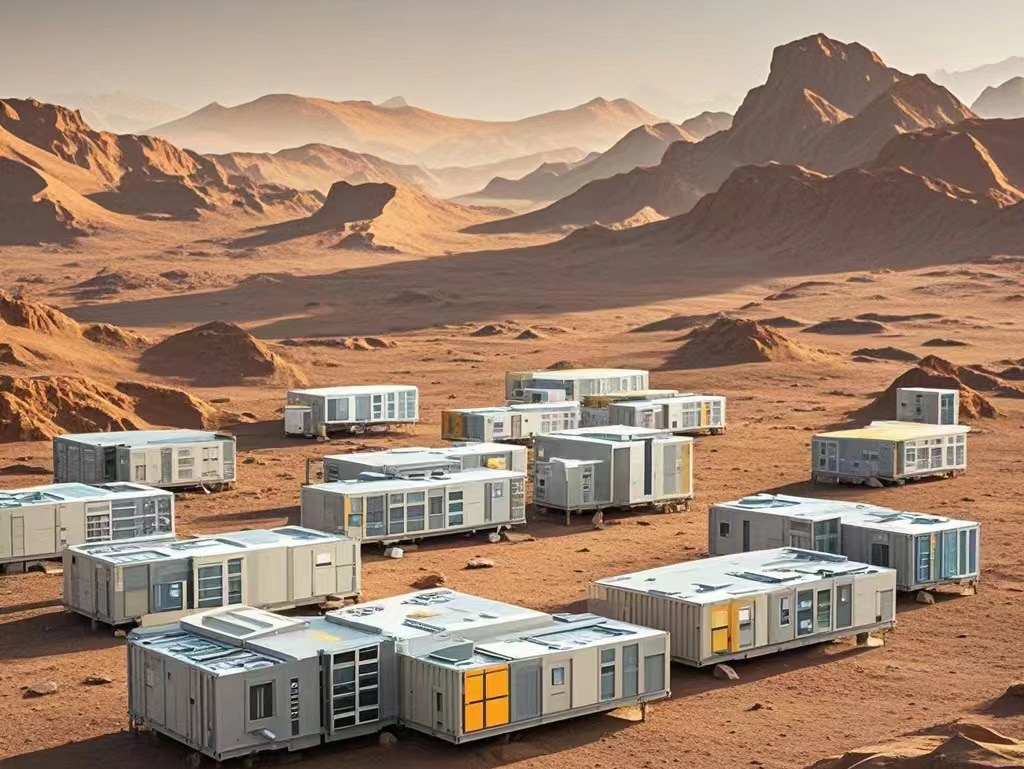
Selecting a landing site is a crucial aspect of Mars exploration missions. On the Martian surface, geologically stable and resource-rich areas are essential for long-term survival and city building. Multiple factors need to be comprehensively considered, including geological stability, solar radiation, underground water sources, and future scalability requirements. Based on these factors, landing site selection will prioritize areas close to water sources and rich in energy resources. Geological stability is the primary condition for landing site selection. Although Mars's surface has some seismic activity and storms, certain geological regions are relatively stable and can provide a reliable landing foundation. Resource-rich areas are particularly important because during Mars's long-term exploration, being able to extract water, oxygen, construction materials, and other resources locally will greatly reduce dependence on Earth's resources. Scientists have discovered through detection instruments that large amounts of underground water ice exist near Mars's north pole, making it an ideal landing area. Additionally, the scalability of future city construction is an important consideration. The landing site must be able to support subsequent base construction, agricultural planting, and resource extraction activities, so the selected area must also have good sunlight conditions to ensure the continuity of solar power generation while guaranteeing sufficient building material supplies. The comprehensive consideration of these conditions ensures that Mars exploration missions have long-term viability and sustainability.
3. Landing Process
The landing process of the spacecraft or containers is a highly precise operation involving multiple complex technologies to ensure the aircraft can land on Mars's surface smoothly and safely. Vertical Takeoff and Landing (VTOL) technology is employed for precision landing in Mars's thin atmosphere. After entering Mars's atmosphere, the aircraft's speed is gradually reduced through atmospheric drag and the reverse thrust of the plasma drive system, entering a more detailed landing phase. First, as the spacecraft or container approaches the Martian surface, it activates the propeller and plasma drive systems. Through aerodynamic and electromagnetically controlled plasma thrust for reverse acceleration, the aircraft's speed can be further reduced, safely transitioning to a low-speed phase. Meanwhile, the aircraft's VTOL system ensures vertical stability with precise control, preventing the aircraft from deviating from its planned trajectory. To address the challenges of Mars's extreme surface environment, the spacecraft is equipped with advanced sensors and navigation systems that monitor flight altitude, speed, atmospheric pressure, and other data in real time, making corresponding adjustments based on terrain and environmental conditions. When the spacecraft is about to land, the precision control system ensures a smooth touchdown, avoiding collisions or tilting. After landing, the aircraft can quickly deploy and support subsequent resource extraction and base construction work, laying the foundation for humanity's survival and development on Mars. Part II: Establishment